
7 Cheapest Email Marketing Tools in 2026 (Free Tiers + Lifetime Deals)
By Dominique Abbey · 2026-06-14
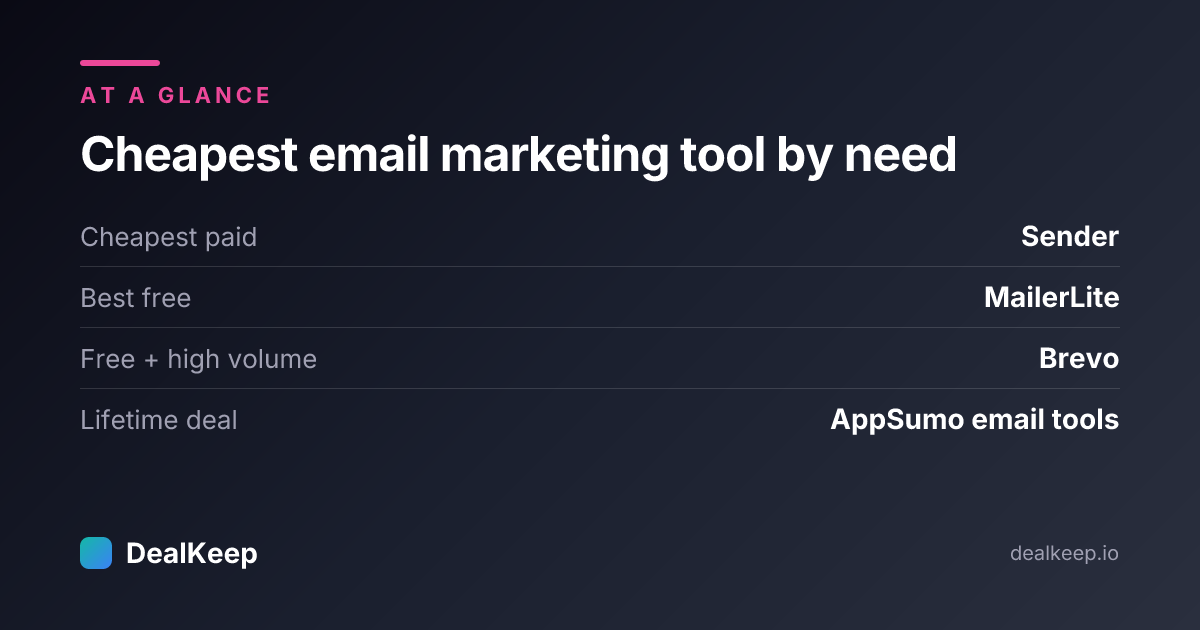
Short answer: the cheapest paid email marketing software is Sender, the best free options are MailerLite and Brevo, and the cheapest long-term route is a one-time lifetime deal. This guide ranks email tools strictly by cost — what you pay at common list sizes — so you can stop overpaying for the brand name. (If you''re leaving a specific tool, see our best Mailchimp alternatives guide.)
Email marketing pricing is confusing on purpose: some tools charge per contact, others per email sent, and "free" plans hide send caps and forced branding. Below, everything is sorted by real-world cost so you can pick the cheapest tool that still lands in the inbox.

Cheapest email tools, ranked by price
| Rank | Tool | Free plan | Cheapest paid | Billed by |
|---|---|---|---|---|
| 1 | Sender | 2,500 subs / 15k emails | ~$8/mo | Contacts |
| 2 | EmailOctopus | 2,500 subs / 10k emails | ~$8/mo | Contacts |
| 3 | Brevo (Sendinblue) | 300 emails/day free | ~$9/mo | Emails sent |
| 4 | MailerLite | 1,000 subs / 12k emails | ~$10/mo | Contacts |
| 5 | Moosend | Trial only | ~$9/mo | Contacts |
| 6 | Mailjet | 6,000 emails/mo free | ~$15/mo | Emails sent |
| 7 | Kit (ConvertKit) | 10,000 subs free | ~$25/mo | Contacts |
The 7 cheapest email marketing tools
1. Sender — cheapest paid plans overall
Sender consistently has the lowest paid pricing of any mainstream tool, plus one of the most generous free tiers (~2,500 subscribers and 15,000 emails/month). It includes automation, segmentation, and even SMS. If your single goal is the lowest bill, Sender wins.
2. EmailOctopus — cheap and simple
EmailOctopus keeps things minimal — campaigns, basic automation, a clean editor — and prices it accordingly. Its free plan covers ~2,500 subscribers, and paid plans start very low. Ideal if you want email marketing without paying for features you''ll never touch.
3. Brevo — cheapest for large, infrequent lists
Brevo bills by emails sent, not contacts stored, so a 20,000-person list you email once a month can cost far less here than anywhere that charges per contact. The free plan allows 300 emails/day, and paid plans are cheap per-send.
4. MailerLite — cheapest with a premium feel
MailerLite is barely more than the rock-bottom options but gives you a much nicer editor, free landing pages, and automations. Its ~1,000-subscriber free plan plus low entry pricing make it the best value when you want cheap and polished.
5. Moosend — cheap automation
Moosend doesn''t have a permanent free plan, but its paid pricing is among the lowest for the automation depth you get — triggered flows, segmentation, and e-commerce features that usually cost much more.
6. Mailjet — cheap email + transactional
Mailjet''s per-send pricing and a free 6,000-emails/month tier make it cheap for teams that need both marketing and transactional email from one place, with real-time template collaboration.
7. Kit (ConvertKit) — cheapest big free plan for creators
Kit''s free plan covers up to ~10,000 subscribers, which is remarkable value for newsletter writers and creators. You pay once you need advanced automations, but for growing an audience cheaply, few free tiers go further.

Photo by olia danilevich on Pexels
What actually makes email software cheap
- Billing model — per-contact pricing punishes big lists; per-email pricing (Brevo, Mailjet) is cheaper if you send infrequently. Match the model to your habits.
- Real free-tier limits — check both subscriber caps and monthly send limits. Sender, EmailOctopus, and Kit lead on free.
- Forced branding & feature gates — a "free" plan that won''t let you automate or remove its logo may push you to upgrade sooner than a slightly smaller free tier that doesn''t.
- Deliverability — the cheapest tool is expensive if your emails hit spam. Stick to senders with strong reputations (MailerLite, Brevo, Sender) and authenticate your domain (SPF/DKIM/DMARC).
- One-time pricing — over a few years, a lifetime deal can be the cheapest option of all (see below).
The cheapest option long-term: lifetime deals
If you''re thinking in years, not months, the cheapest email marketing software might be one you pay for once. Email and marketing tools regularly appear as one-time lifetime deals on marketplaces like AppSumo — a single payment instead of a forever subscription. The risk is buying deals you forget to use. DealKeep helps you find the best lifetime-deal tools and track every deal and subscription in one place so a one-time email tool actually pays off.
FAQ
What is the cheapest email marketing software? For paid plans, Sender is typically the cheapest mainstream option, with EmailOctopus close behind. For free, MailerLite and Brevo lead. For lowest lifetime cost, a one-time lifetime deal can beat any subscription over a few years.
Is there a cheaper alternative to Mailchimp? Yes — almost all of them. Sender, EmailOctopus, MailerLite, and Brevo all cost less than Mailchimp at the same list size, with comparable or better free tiers. See our full Mailchimp alternatives guide for a feature-by-feature comparison.
How much is a 1,000-subscriber list worth (to email)? Usually $0. MailerLite, Sender, EmailOctopus, and Kit all cover a 1,000-subscriber list on their free plans, so you shouldn''t pay anything to email a list that size.
What is the 80/20 rule in email marketing? The 80/20 rule suggests roughly 80% of your emails should give value (useful, relevant content) and only about 20% should directly sell. It keeps subscribers engaged and your unsubscribe and spam rates low — which, in turn, protects deliverability and keeps your costs down.
Is Mailchimp actually free? Mailchimp has a free plan, but it has been trimmed over time (lower send limits and fewer features) and adds Mailchimp branding. Cheaper alternatives like Sender and MailerLite generally offer more generous free tiers.
Prices and free-tier limits are approximate and change often — check each tool''s current plans before buying.